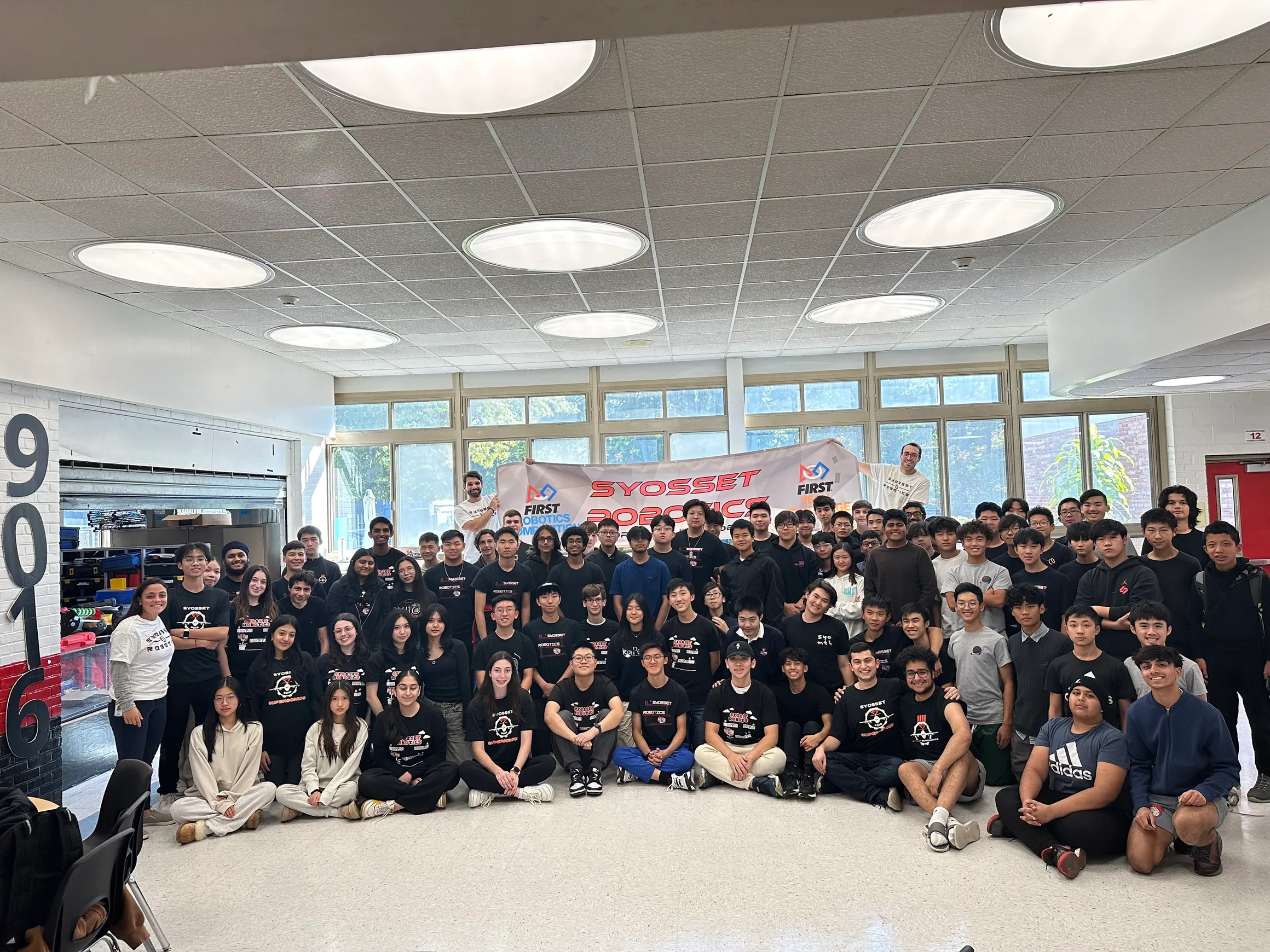
By: Elaine Liu & Alan Wang
From designing complex conveyor-shooter mechanisms that launch balls with precision to crunching calculations that bring robots to life, Syosset High School’s premier robotics team—the Syosset SuperSonics—has dedicated countless hours to innovating and problem-solving. The team dedicated countless hours preparing for Long Island Regionals, affiliated with the For Inspiration and Recognition of Science and Technology (FIRST) Robotics Competition, held at Hofstra University from March 18 to March 21.
This event was highly anticipated as one of their most important competitions across New York, determining which teams qualify for the World Championship at Houston. This year was especially significant, as the team sets its sights on qualifying for its fourth consecutive trip to Worlds since its establishment. What began just four years ago, when the Syosset SuperSonics first joined the hundreds of robotics teams nationwide, has grown into a program that thrives across various categories: the FIRST Lego League, the FIRST Tech Challenge, and of this upcoming Regionals in particular, the FIRST Robotics Competition.
With the excitement of Regionals forthcoming, students from various departments such as Electrical, Mechanical, Design, and Programming worked together in Room A6/7, the home of Syosset’s robotics team. To create a successful robot, different departments will sketch out designs on paper, create a 3D model online, and test various different materials to maximize speed, efficiency and power. All these components are crucial to the overall development of the robot. For the competition, senior Nora Han said, “Our robot is a shooter robot; we have a bumper intake that intakes as many balls as we can from the ground, which feeds into our conveyors that go to triple fixed shooters.” These mechanisms serve the main goal of scoring fuel, represented by balls, into hubs of the corresponding color.
With such a complex robot to build, members collaborated closely with coaches to tweak their design and adjust their strategy, even as challenges arise. From the coaches’ perspective, this process can thus be very demanding. Coaches John Chae said, “The most challenging part was not being able to give programmers enough time to run their programs and test it because it took so long to finish the robot, and our programmers only had one or two days to run the program.” Given the collaborative nature of robotics where every component, from programming to design, is essential for success in qualification matches and advancing to playoffs, the team developed a strong sense of spirit and close-knit bonding. This unity helped propel the Syosset SuperSonics to Worlds in the past, and this year, the team hopes to continue that legacy as they aim to join other top-ranked teams in advancing once again.