By: Ella D’Auria
Serious question: when was the last time you sat down, voluntarily, to read a book? I’m willing to bet the answer is closer to when you read bedtime stories in your childhood than it is to today. Literacy rates are on a steady decline—perhaps due to more time on social media, or because teachers are assigning fewer books per year than ever—and I think it’s about time we started a new chapter. So, let me tell you about a few great classics to keep you booked and busy—with something other than TikTok.
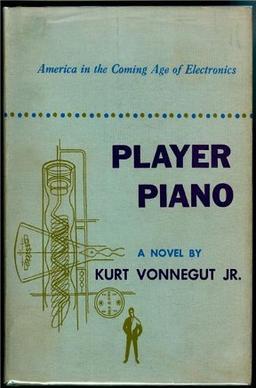
Player Piano by Kurt Vonnegut (1952)
If you’re the kid who had all of The Hunger Games read before the fifth grade, this is the book for you. And if you’re the person who has their own AI startup, this is also the book for you. Player Piano is a dystopian satire in which machines have superseded most of human labor. Jobs are displaced, rioting begins, and the gap between the captains of industry and the “exceedingly average” grows incessantly. Given our recent technological and social developments, the dilemmas of the text are eerily familiar. Vonnegut eloquently explores this issue of what happens to a person when they’re no longer needed economically. But, further, what happens to a person when they’re no longer needed? What gives the human life purpose?
To this end, the book is also a critique of how we measure aptitude. Ilium, New York runs as an ostensible meritocracy, using a civic examination with rigid criteria to determine a person’s aptitude for various careers. However, the system’s neutrality belies its inequality. Especially today, with the reign of standardized testing, resume filtering, and algorithmic decision-making, we live in a society that operates on very similar, inflexible criteria. But what happens when complex human characteristics are flattened into numbers? Vonnegut’s stance seems to be concerned with what values, what people become expendable when this procedure dominates our “meritocracy.”
Player Piano is a compelling case study, not only as Vonnegut’s first published novel, but also for its interrogation of issues bearing uncanny resemblance to today’s. The book is a truly meaningful read, whether you’re team tech or not. At the very least, you’ll get a good laugh out of Vonnegut’s dark humor.
East of Eden by John Steinbeck (1952)
When you sit down for this book, I can assure you that you are in for both a good time and a long time. Sitting at somewhere around six hundred pages, this book is a thoroughly developed and beautifully rendered classic. But I’d urge you not to let the size deter you; the book does move rather quickly. The prose is highly accessible, yet Steinbeck writes in a way that is still profound.
If you have a hard time keeping up with one flat storyline, this text will be refreshing. Various plotlines and issues coexist in the text, so it is hard to get bored: something always feels new. However, what I think sets this book apart is the plot—there are some serious plot twists and jaw-dropping moments. Investing yourself in the chronology and the substance of the narrative will absolutely be worth your while.
More importantly, the text is a contemporary retelling of the story of Cain and Abel—whatever your beliefs, that story has a universality to it. You will find yourself in every character of the text, and the length of the novel ensures that you truly build a connection to the characters: the insightful Lee, the naive Adam. You might just find yourself rooting for the Cain-like figures by the end.
As for the message, the text promises that there is good and evil in all of us. If you found yourself knee-deep in the Wicked craze for the past two years, you will find this text familiar and enjoyable. East of Eden promises that nobody is purely good or evil, and what makes us human is that every day we try our best. We aren’t defined by our history, and we can choose goodness. I think everyone deserves to hear that promise at some point in their life.
The Sound and the Fury by William Faulkner (1929)
Anyone who knows me knows this is my favorite book of all time. If there is only one book you read in your lifetime, it should be this—and I will die on that hill. That said, it is a hard book, and anomalous from the two aforementioned in that it is not a book you can sit down and merely get through. The Sound and the Fury requires a decent amount of rereading, supplementary research, and a real desire to understand to appreciate it fully. It seems like more work than it’s worth, but I wouldn’t recommend the novel to anyone if it weren’t.
So, what sets Faulkner’s writing apart? Much of the text follows a stream-of-consciousness technique; Faulkner writes the way thoughts happen: nonlinearly, associatively, and intensely. This experiment of being inside the character’s mind thus adds such an immediacy to the story—one that emphasizes raw feeling over a clear understanding.
The story is narrated (or perhaps “repeated” would be a better word choice of diction, for it is essentially the same story told over in a new way) by four separate characters—each with a distinct style and contradictory narrative. This fragmentation, when consumed together, creates a story that is so uniquely holistic. Your understanding of each character will closely approach the truth, given that you see them from such a dynamic lens. Similarly, it is satisfying to see the logical holes filled in as the same narrative is recapitulated. By the end of the text, you’re rewarded with myriad “aha” moments and a real feeling of discovery—not to mention a much-deserved sense of accomplishment.
Mucking one’s way through dense prose is not for everyone, certainly not when the prose can be utterly incoherent. I personally find the language to be vibrant and beautifully sophisticated, which is something often unique to this era of writing. But just because the contents of the text may look or sound old, doesn’t mean the story is, too. While the plot is perhaps antiquated, yes, the themes of the text are, to me, universal—timeless. And with the addition of Faulkner’s stream-of-consciousness technique, I believe it speaks so personally to the nature of our human condition. In the words of Lee from East of Eden: “I here make a rule—a great and lasting story is about everyone or it will not last…only the deeply personal and familiar.” In my opinion, The Sound and the Fury is just that kind of story.